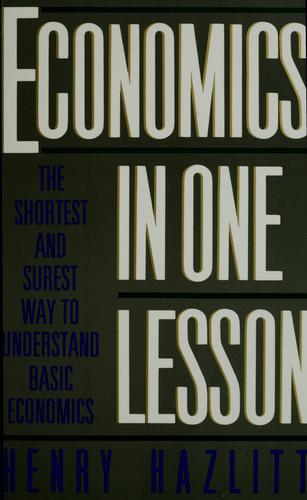
Economics in One Lesson
Henry Hazlitt
45 people recommended it in 18 threads, 2007–2022.
5 commenters pushed back on it — worth reading the threads.
What people on Hacker News said
After this book, I now think much more carefully about proposed policies/rules/business strategies/etc. "Subsidized child care" or "charge businesses per seat" can sound great on the surface, but specific proposals often have so many unintended or negative consequences that are not discussed, and it's important to weigh those consequences against the benefits.
The title doesn't do it justice because it sounds so cliche, but once you read it, you'll actually agree that this DOES cover everything you need to know about economics (although heavily biased towards austrian economics than keynesian)
It's old but many of the lessons he teaches are still relevant today. It opened my eyes to the danger of only thinking about the things that are easily observable, and ignoring the "unseen" things.
The art of economics consists in looking not merely at the immediate but at the longer effects of any act or policy; it consists in tracing the consequences of that policy not merely for one group but for all groups.
E.g. the very first chapter, the "One Lesson" (on the Broken window fallacy: http://en.wikipedia.org/wiki/Broken_window_fallacy) will right off explain to you why "Cash For Clunkers" was such a clunker.
Explains classical economics in a way where I now can understand what politicians are talking about.
So in that spirit, here are a couple of economics books that I quite seriously believe everyone should be forced to read.
And on Amazon
Economics In One Lesson Review
The book Economics In One Lesson is about economic policies, and how these policies should take into account the effect they will have on everyone involved, not just one group. It also discusses and illustrates how economics should be focused on long term effects, rather than ignoring or overlooking the long term and only focusing on the short term. The author states that the most common fallacy in economics is to concentrate on the short-run effects of policies on special groups and to ignore or belittle the long-run effects on the community as a whole. …
Justin Thole · verified purchase · 5/5
THE Economics Primer!
The subtitle of the book says it all. This is definitely "the shortest and surest way to understand basic economics". The author takes a unique approach by introducing all the main concepts through "exposition". As he says "...its effort is to show that many of the ideas which now pass for brilliant innovations and advances are in fact mere revivals of ancient errors, and a further proof of the dictum that those who are ignorant of the past are condemned to repeat it." The main premise of the book is that: "Economics, as we have now seen again and again, is a science of recognizing secondary consequences. …
O. Halabieh · verified purchase · 5/5
An old book with an enduring lesson
I have read Economics in One Lesson more than once, and I find myself returning to it because its central lesson remains remarkably relevant. First published in 1946, Henry Hazlitt's book asks the reader to develop a simple but powerful habit of thinking: look beyond the immediate effects of an economic policy and consider its consequences for everyone, over time. In other words, don't judge a policy solely by what it appears to accomplish for the people immediately affected. Ask what is unseen, what is displaced, what the opportunity costs are, and who ultimately bears the cost. …
John P. Camey · verified purchase · 5/5
Where it comes up
- Ask HN: What are the must-read books about economics/finance? 2016 · 9 recommendations
- Ask HN: What books changed the way you think about almost everything? 2019 · 6 recommendations
- Ask HN: Best book(s) to learn about the basics of economics? 2010 · 5 recommendations
- Ask HN: What book have you given as a gift? 2016 · 4 recommendations
- Ask HN: Book recommendations for understanding financial systems? 2020 · 3 recommendations
- Ask HN: What's one book that changed your life? 2018 · 3 recommendations
- Ask HN: Great books you read in 2009? 2010 · 2 recommendations
- Good book for economics 2008 · 2 recommendations
- What books would you recommend reading? Why? 2007 · 2 recommendations
- Ask HN: Which books have made you a better thinker and problem solver? 2022 · 1 recommendation
- Ask HN: Do you recall any book or course that made a topic finally click? 2022 · 1 recommendation
- Ask HN: Books you plan to read in 2020? 2019 · 1 recommendation
- Ask HN: Which books have made you introspect? 2018 · 1 recommendation
- Ask HN: Books you read in 2016? 2016 · 1 recommendation
- Ask HN: What books have you read in the first half of 2016? 2016 · 1 recommendation
- Top Books on Amazon Based on Links in Hacker News Comments 2016 · 1 recommendation
- Ask HN: What book changed your life in 2014? 2014 · 1 recommendation
- Ask HN: What book changed your life in 2013? 2013 · 1 recommendation