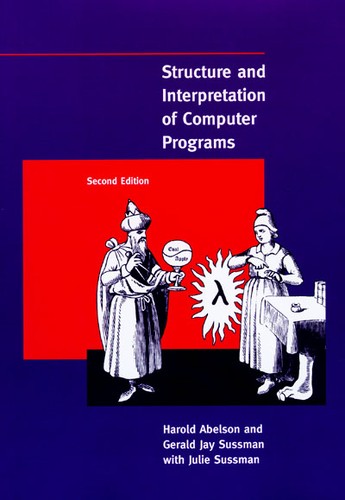
Structure and Interpretation of Computer Programs
Harold Abelson
316 people recommended it in 122 threads, 2007–2026.
3 of those were in the last year.
25 commenters pushed back on it — worth reading the threads.
What people on Hacker News said
Even though I had worked through SICP I still watched all the lectures again and implemented all the examples with benchmarks and unit tests.
There's over 200 pages before they even introduce mutation and impure functions. Later they touch on the thorny problems that mutation creates when they touch on concurrent programming.
This book helped me think about how programs run, how state is stored, how you can build out asynchronous computation, and how you can build your own languages.
This is a bit unorthodox, but I personally got a lot out of taking the LISP code in Structure and Interpretation of Computer Programs, and mentally translating the examples and solving the exercises in Javascript.
SICP, JS edition (great read, I do a lot of JS work and I’ve learned a lot, despite time spent studying the language itself, and I’m still in the first chapter)
And on Amazon
The Art of Generalization.. TOUGH but possibly worth it
Inductive reasoning aims at simplifying functions just enough to make them general. Simple does NOT equal easy! When Functional Programming (and its predecessors-- combinatory logic (1925) and lambda calculus (1930)) were first invented, they were aimed at clarifying mathematical logic. This "holding variables constant" or binding or eliminating them for "pure" (mathematical) functions, has been extended to Functional Programming, initially to better understand what programming is in general, then to evaluate mathematical functions while avoiding some of the complicating factors (side effects) of imperative/procedural programming. …
Professor dot biz · verified purchase · 5/5
Computer Science...Art?
You need it, too. I won't pretend to have more useful insight into the art and craft of programming, or into SICP's relationship to it, than Paul Graham or Peter Norvig- if you want to know which reviews to trust, look these cats up. The discussion in the reviews usually concludes that this is the book that separates the computer scientists from the mere programmers. There is a definite logic to this. …
B. Dean · verified purchase · 5/5
The best programming book ever, if you're a certain kind of person
This was the book that made me want to be a computer programmer. When I read it, I had no knowledge of programming beyond a little Pascal, and rudiments of C. It had a massive impact on me. It consumed me, to the point where I had difficulty finishing assignments for my classes (I did not study CS as an undergrad). What the book does is give you a vocabulary and knowledge about programming that is hard to find anywhere else. …
Jaime Silvela · verified purchase · 5/5
Where it comes up
- Reddit's favorite programming books, from 3.5B comments 2017 · 15 recommendations
- SICP: The only computer science book worth reading twice? (2010) 2024 · 14 recommendations
- Ask HN: What language-agnostic programming books should I read? 2017 · 13 recommendations
- Books that changed my career as a software engineer 2021 · 12 recommendations
- Ask HN: What are the most fundamental books on computer science? 2019 · 11 recommendations
- Alan Kay's answer to ‘what are some forgotten books programmers should read?’ 2019 · 10 recommendations
- What is the single most influential book every programmer should read? 2011 · 10 recommendations
- Ask HN: What, in your opinion, are the greatest and most useful textbooks? 2020 · 9 recommendations
- Ask HN: The book that did it for you in math and/or CS? 2022 · 8 recommendations
- Ask HN: What's the best computer science book you've read recently? 2017 · 8 recommendations
- Books for Software Engineers in 2023 2023 · 7 recommendations
- Ask HN: Which books you have read till now that were worth investing time in? 2022 · 7 recommendations
- The most mentioned books on Stack Overflow 2017 · 7 recommendations
- Top Books on Amazon Based on Links in Hacker News Comments 2016 · 7 recommendations
- Must Read CS Books For Self Self-Taught Programmers 2011 · 7 recommendations
- Ask HN: What's the best textbook you've read? 2018 · 6 recommendations
- Prof. Sussman's Reading List 2015 · 6 recommendations
- What is the single most influential book every programmer should read? 2011 · 6 recommendations
- Ask HN: What are the most eye-opening textbooks you have ever read? 2023 · 4 recommendations
- Ask HN: Books that teach programming by building a series of small projects? 2023 · 4 recommendations