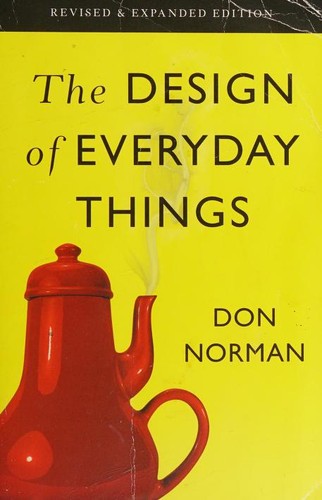
The Design of Everyday Things
Don Norman
95 people recommended it in 40 threads, 2007–2024.
5 commenters pushed back on it — worth reading the threads.
What people on Hacker News said
The Design of Everyday Things makes me rethink every user interaction or problem I face, and not just at work. Every time I open a door, I begin to think about that experience.
His formalization of how humans interact with things (form a plan to reach a goal -> interact with the thing to advance toward said goal -> evaluate the outcome, rinse repeat) and the potential error sources on the way (distractions, unclear consequences, unclear affordances...) make it obvious why in many functional languages, the REPL is such a great tool.
This book ruined my life. I highly recommend it. Every engineer, manager and designer should read this. Maybe every human. I think of this book every time I try to pull a push door, every time I reach the bottom floor of a stairwell and notice the design that might save my life one day, and every time I try to struggle to operate a television or a microwave.
The Design of Everyday Things. Probably the quintessential book on design, the basic premise is that if you can't figure out how a thing works, it's not your fault.
Yes, API design has its own gotchas and specific practices—but some of the best (and worst) APIs I’ve ever interacted with were good (or bad) for the same reasons any kind of design can be good ( or bad): affordances, feedback, coherent conceptual models, and so on.
Technically this book is about how humans interact with things, but actually it covers a lot more topics that one can think: how humans act, err, how they make descisions, how memory works, what are the responsibilities of conscious/subconscious. Also you'll start to dislike doors, kitchen stoves and their disigners)
not only UX. programmers can actually learn a lot about building software if they see the meta in the book (replace door w/ interface. think about the mental model your library user is going to build for your library. make things easy to use when the correct pattern is employed and impossible if improperly done. minimize cognitive load)
At least once a day I catch myself thinking some everyday object (or app) I’ve encountered could be more usable if it had certain signifiers to better illustrate its affordances, or lacked certain signifiers to obfuscate unintended affordances. Should be required reading for anyone who aspires to put products out into the world.
“The Design of Everyday Things” changed the way I see literally everything. You’ll never look at doors the same way again, and prepare to forever be frustrated by poorly designed objects, and delighted by incredibly well designed ones.
Where it comes up
- Ask HN: What books changed the way you think about almost everything? 2019 · 13 recommendations
- Ask HN: What's the best book on modern UI/UX? 2018 · 12 recommendations
- Ask HN: Suggestions for books about API design? 2020 · 7 recommendations
- Ask HN: What book changed your life? 2022 · 4 recommendations
- The most mentioned books on Stack Overflow 2017 · 4 recommendations
- Ask HN: Good books or articles on UI design? 2016 · 4 recommendations
- Ask HN: Which books do you consider real gems in your field of work/study? 2022 · 3 recommendations
- Ask HN: Which book can attract anyone towards your field of study? 2022 · 3 recommendations
- Books I recommend to my software engineering students 2020 · 3 recommendations
- Ask HN: Favorite nonfiction books of 2018? 2018 · 3 recommendations
- Ask HN: What are the best textbooks in your field of expertise? 2018 · 3 recommendations
- Ask HN: What books have made the biggest impact on your mental models? 2017 · 3 recommendations
- Ask HN: Mind bending books to read and never be the same as before? 2020 · 2 recommendations
- Alan Kay's answer to ‘what are some forgotten books programmers should read?’ 2019 · 2 recommendations
- Best development book I've read, has no code in it 2014 · 2 recommendations
- What is the book that has completely changed your way of thinking? 2011 · 2 recommendations
- Ask YC: favorite books 2007 · 2 recommendations
- Ask HN: What's the "best" book you've ever read? 2024 · 1 recommendation
- Extracting Hacker News book recommendations with the ChatGPT API 2023 · 1 recommendation
- Ask HN: What are the most eye-opening textbooks you have ever read? 2023 · 1 recommendation